The Debate Is Really About Application
No engineered panel is universally better. Each is a trade-off between cost, strength, moisture resistance and finishability. The right question is not "which is best" but "which suits this unit, in this environment, at this price".
At a Glance
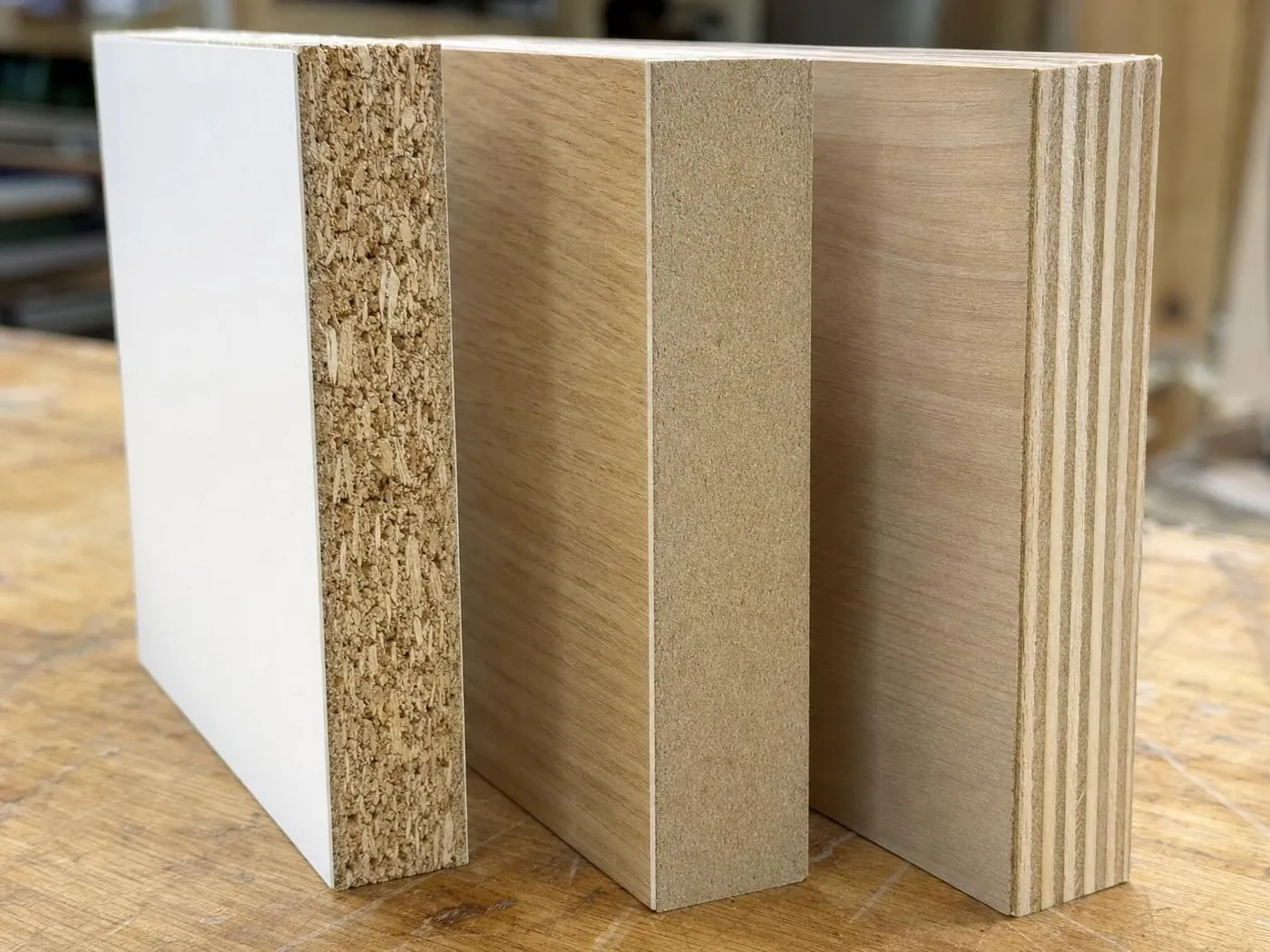
- Particle board — lowest cost, stable, laminates well, moderate screw-holding, poor moisture resistance.
- Plywood — high strength and screw-holding, good moisture resistance, higher cost, visible edge requires banding.
- MDF — smooth, machines and paints beautifully, takes routed profiles, heavier, lower screw-holding on edges.
Matching Material to Product
- Wardrobe carcasses: particle board is usually sufficient; plywood for high-load or humid locations.
- Kitchen cabinets: plywood or moisture-resistant board near sinks; MDF for painted doors.
- Bathroom or laundry units: plywood — moisture resistance matters more than price.
- Curved or routed fronts: MDF, for its clean machining.
- Long shelves: plywood or blockboard to resist sagging.
What Drives Cost
Panel cost, edge treatment, hardware grade and finish labour each move the final price. A buyer can usually hit a target price by mixing materials — particle board where it is hidden, plywood where it is structural — rather than downgrading the whole unit and accepting a durability risk.
The Hidden Variable: Edge Quality
Two cabinets can use identical board and still perform very differently, because the edge is where moisture enters and where cheap work shows first. Properly sealed, fully adhered edge banding matters more than many buyers realise, and it is worth asking about explicitly.
Specification Checklist
- Which board is used in each component? (Ask for it in writing.)
- What edge banding material, adhesive and machine are used?
- What hardware load rating — particularly on hinges and drawer runners?
- How is colour consistency controlled between batches?
Ask for the Specification
A good manufacturer will tell you exactly which board is used where, and why. Ask for it in writing, and compare quotations on material and construction, not on price alone.
Frequently Asked Questions
Is particle board good enough for wardrobes?
For carcasses in dry, moderate-load interiors, yes. For load-bearing or humid positions, plywood is the safer choice.
Why is plywood more expensive?
Cross-layered veneers cost more to produce than bonded chips, but they deliver far higher screw-holding strength and moisture resistance.
Can you supply material specifications in writing?
Yes. We will state exactly which board is used in each component, along with edge banding and hardware specifications.