
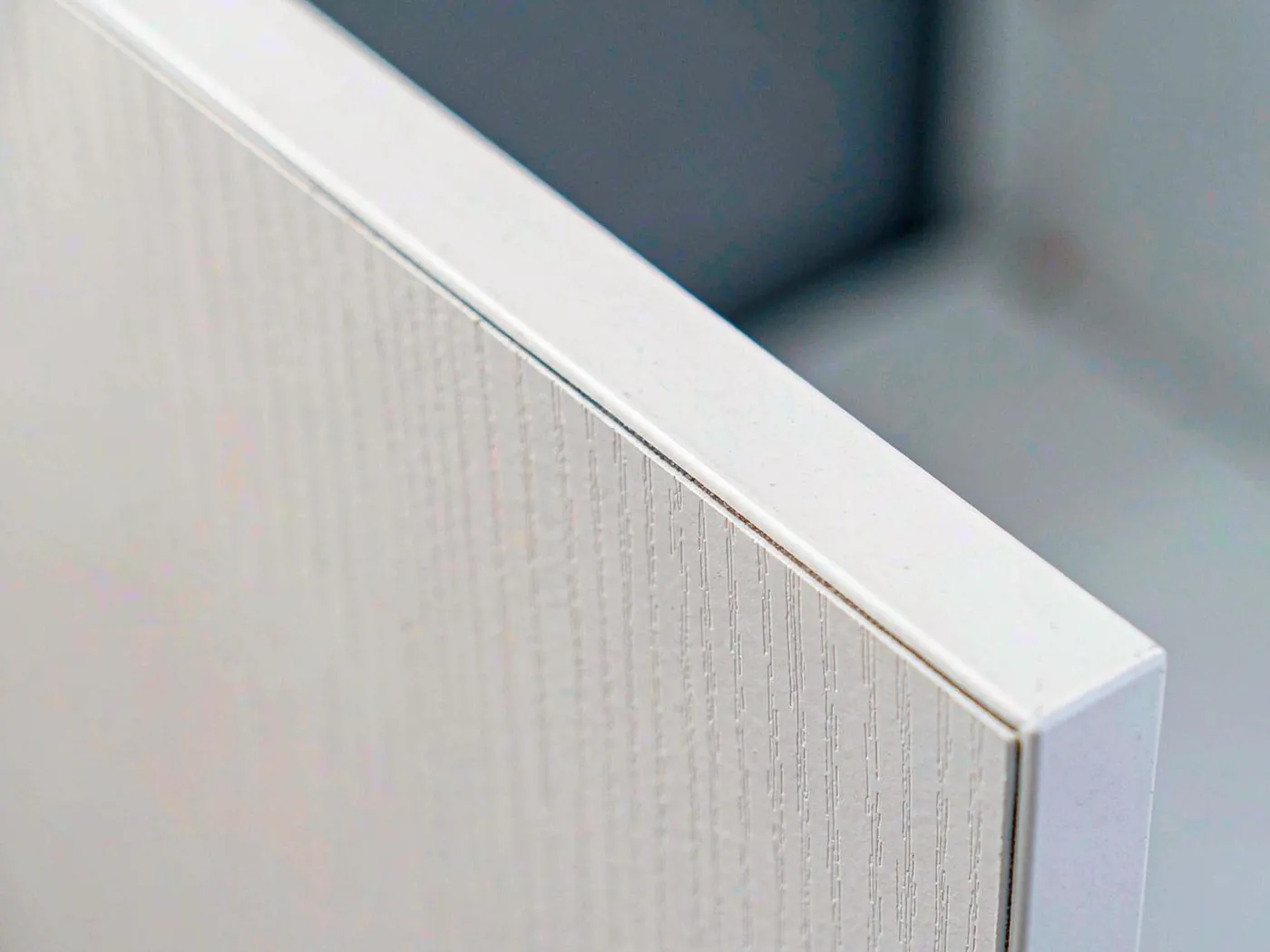
The Detail You Cannot Hide
Buyers often judge cabinetry by its surfaces, but the edge tells the truer story. Poorly banded edges peel, absorb moisture and look cheap within months. Excellent edge work is nearly invisible to the eye, which is exactly the point: it simply looks like a solid, well-made panel.
What Edge Banding Does
Engineered panels have an exposed core at every cut edge. Edge banding seals that core, protects it from moisture, and gives the panel a finished appearance. It is a thin strip with a large effect on durability — and it is the component most likely to fail first in a humid climate.
What Good Banding Looks Like
- Full adhesion with no gaps, lifting or trapped debris
- Clean trimming flush with the panel face, with no overhang or shaving marks
- Colour match to the panel surface, or a deliberate contrast
- Rounding on handling edges to resist catching and chipping
Joins That Signal Craft
45° Mitred Joints
Two panels meet at an angled seam so no edge is visible from the front. It is harder to execute than a butt joint but produces a cleaner, more premium appearance — and it is a reliable indicator of a factory's machining quality.
Beveled Corners
Angled corner details add visual refinement and are a hallmark of higher-end cabinetry.
Curved and Arched Edges
Rounded and arched elements require proper routing and finishing; done well, they define the cream-style and light-luxury looks now in demand.
Machine Types, Briefly
Edge banding quality depends heavily on equipment. Manual application is cheap but inconsistent. Semi-automatic machines improve consistency. Fully automatic lines with end-trimming, top-and-bottom trimming and profile-scraping units deliver the tight, uniform result that premium cabinetry requires. Ask what type of line your order will run on.
Inspection Tips for Buyers
- Run a fingernail along the edge — it should feel smooth and continuous, never catching.
- Look at the joint line in raking light to spot gaps or glue squeeze-out.
- Check several panels, not just the one presented to you.
- Check edges in the least visible places; that is where corners are most often cut.
Why This Matters When Sourcing
Ask a factory how it controls edge quality — machine type, adhesive, trimming and inspection. The answers separate manufacturers who understand cabinetry from those who merely cut panels.
Frequently Asked Questions
What causes edge banding to fail?
Poor adhesion, inadequate trimming, low-quality tape, or humidity reaching an unsealed core. Machine type and adhesive both matter.
Why do mitred joints cost more?
They require more precise machining and careful assembly than a butt joint, but they hide the panel edge entirely for a cleaner front.
How can I check edge quality before ordering?
Run a fingernail along a finished edge, inspect the joint line in raking light, and check several panels — including in less visible places.