Material Is a Design Decision
In custom cabinetry, the panel is the product. Choosing the wrong board shows up as sagging shelves, swollen edges or a door that will not sit flat after a humid season. We treat material selection as an engineering choice, not a cost-cutting step — and we are transparent about which board goes where.
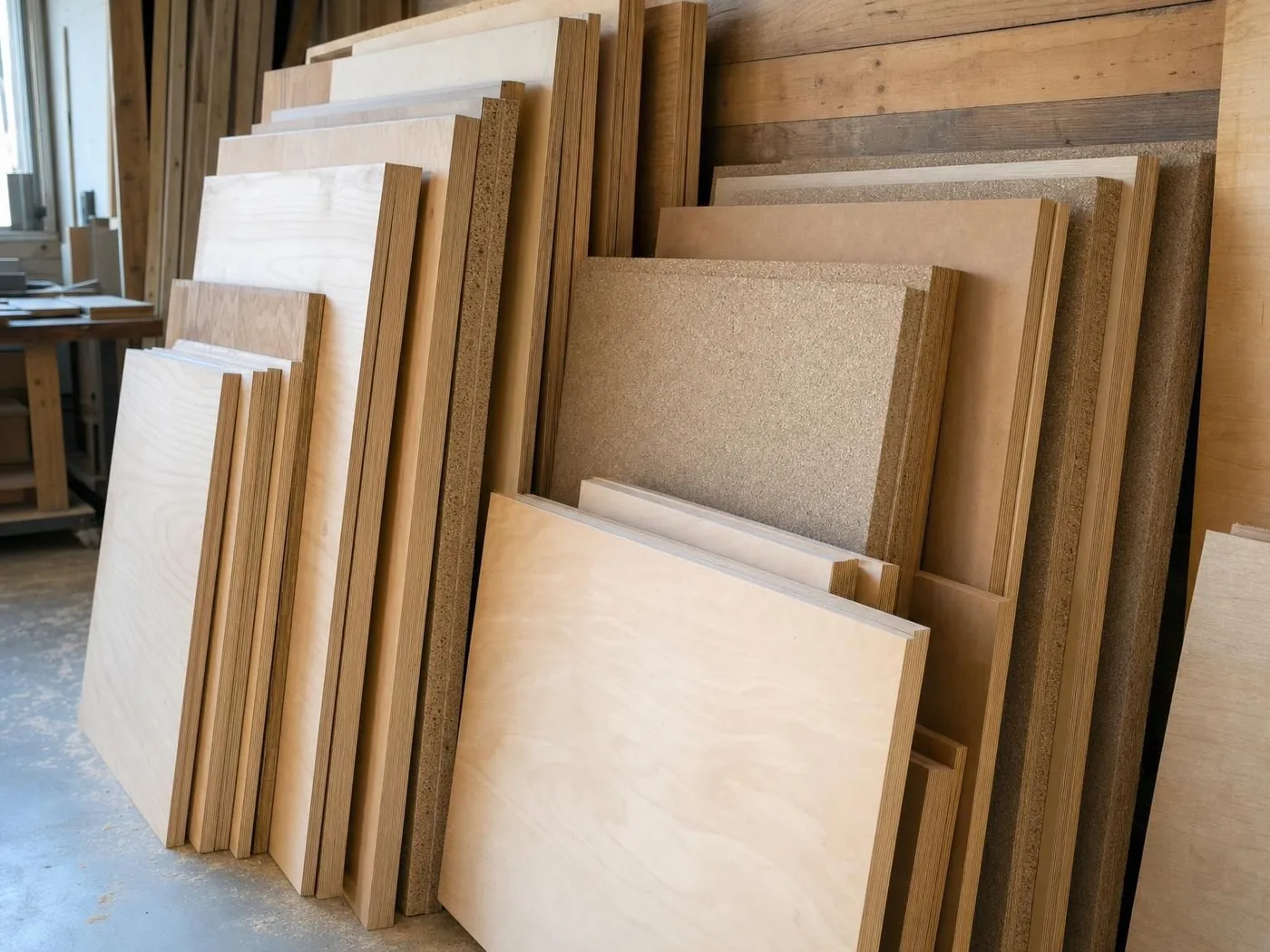
The Four Core Panels
Particle Board
Made from wood chips bonded with resin. It is dimensionally stable, takes lamination well, and is cost-effective for large flat panels such as wardrobe carcasses and cabinet doors. Best for dry interior applications where load is moderate.
Plywood (Multi-Layer Board)
Cross-layered veneers give plywood high screw-holding strength and good moisture resistance. We use it for structural components, load-bearing shelving and any unit facing humid conditions — kitchens, laundries and bathrooms.
Blockboard
A core of solid wood strips sandwiched between veneers. Light and strong, it resists warping well and is a good choice for long shelving runs and larger doors where flatness matters.
MDF (Density Board)
Uniform and fine-grained, MDF machines cleanly and takes routed profiles and painted finishes beautifully. It is our go-to for shaped, curved and painted fronts, including the arched doors now popular in cream-style interiors.
How We Match Board to Purpose
- Where is it? Dry interiors tolerate particle board; wet areas call for plywood.
- What load does it carry? Long shelves need plywood or blockboard to resist sagging.
- What finish is required? Painted or routed profiles favour MDF.
- How is it used? High-cycle doors and drawers justify better hardware regardless of panel.
- What is the budget tier? We mix boards to hit a target price without compromising structure.
The Cost of Cheap Board
Downgrading a whole unit to save a small percentage usually backfires. Swollen edges from a humid kitchen, a shelf that bows under books, or a door that warps after one summer all generate returns and reputation damage far exceeding the saving. Mixing materials intelligently — cost-efficient board where it is hidden, stronger board where it is structural — is almost always the better answer.
Tell Us the Application
Send us the unit type, the environment it will live in and your target price band. We will recommend a panel combination that holds up, and explain the trade-offs honestly rather than quoting the cheapest option by default.
Frequently Asked Questions
Which board is best for a kitchen?
Plywood or a moisture-resistant board near sinks and dishwashers, where humidity is highest. Particle board is adequate in dry, upper positions.
Can you mix materials in one unit?
Yes, and we often do. Using cost-efficient board where it is hidden and stronger board where it is structural is the standard way to control price without sacrificing durability.
How do you stop edges from swelling?
By fully sealing every cut edge with properly adhered edge banding. It is a small component, but it is what keeps moisture out of the panel core.